EECS Instructional Support Group, Department of Electrical Engineering & Computer Science
[ ISG home page ] [ who we are ] [ send us email ] [ search ] [ FAQ ]

Connecting
to the EECS Instructional Computers

Topics:
  • How Do I Get an Account?   [grad students]
  • How Do I Find a Lab or a Logon Server?
  • How Do I Connect using a Modem?
  • How Do I Connect over the Network?
  • How Do I Copy Files Between Computers?
  • How Do I Display UNIX Graphics to My Computer?
  • How Do I Manage Email?
  • How Do I Find Software?
  • How Do I Access Newsgroups?
  • How Can I Be Sure My Password and Files are Private?
  • How Do I Set a Second Password or Password-less Access?
  • How Do I Install SSH at Home?

  • How Do I Get an Account?

    Students in EE and CS classes can get one or more of these accounts from EECS:

    1.   Instructional "named" account:

    • Generalized account for many classes.
    • EECS and CS majors keep them until they graduate.
    • Get one by logging in as 'newacct'   (passwd: 'newacct')
      in 199 Cory, 273 Soda or over the net using 'ssh' to cory.eecs.berkeley.edu.   If you are not enrolled via TeleBears, submit an Account Request Form (from 386 Cory, or print the form here) and obtain the appropriate signature so you can be authorized to run 'newacct'.
    2.   Instructional "class" account:

    • Specialized account for a specific class.
    • Only good for 1 semester.
    • Get one from your instructor in class.
    both "named" and "class" accounts:

    See http://inst.eecs.berkeley.edu/webacct for a summary of your instructional accounts and print quotas.


    Users with EECS research accounts:

    Users with existing EECS research accounts must obtain Instructional privileges before they can use Instructional printers and other resources.   To add Instructional privileges to an existing account, login as 'newacct'   (passwd: 'newacct') as described above.

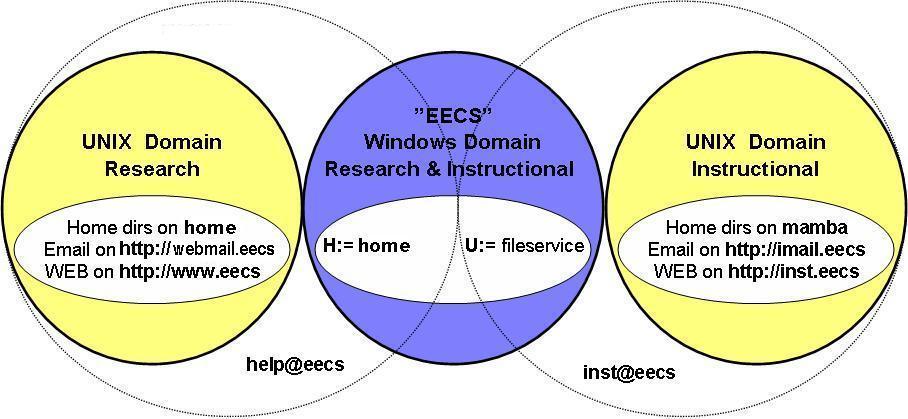
    acct-diagram-Sp07.jpg

    Computer accounts in EECS
    (Research and Instructional accounts use different computer resources)

    EECS grad students are issued a research account, which uses computers, printers, email, WEB sites, software and wireless that are supported for research.

    The research account is your primary account.

      EECS grad students can also request an instructional account, which uses computers, printers, email, WEB sites and software that are supported for classes.

    You may need the instructional account for software or computers that classes use.


    Here are some distinctions between the research and the instructional accounts:

    Windows password:
    • Instructional and research Windows computers are in same domain, so the logon names and passwords are the same.
    • Your research Windows account will work on the instructional computers, with the same password.
    UNIX password:
    • Instructional and research UNIX computers have different domains, so the passwords differ even though the login names are the same.
    • Your research UNIX account will not work on the instructional computers, but if you request an instructional UNIX account (using 'newacct'), you will get one with the same login name as your research UNIX account (but with a different password...)
    home directories:
    • Instructional UNIX home dirs are on mamba.cs
    • Research UNIX home dirs are on coeus.cs
    • Instructional Windows home dirs are on fileservice.eecs (U:)
    • Research Windows home dirs are on coeus.cs (H:)
    Email address:
    WEB page:
    Logon servers:
    • Instructional logon servers include cory.eecs (UNIX),   iserver2.eecs (Windows).
    • Research logon servers include argus.eecs (UNIX),   hermes.eecs (Windows).
    Wireless network:
    • Instructional people use "AirBears"
    • Research people can also use "EECS"
    Help:
    • Instructional support is inst@eecs (386 Cory, 333 Soda)
    • Research support is help@eecs (395 Cory)
    Please see Finding Computer Resources in EECS for additional comparisons.
    Please see microsoft.help for information about connecting to all of your home directories at the same time.


    How Do I Find a Lab or a Logon Server?

  • EECS Instructional labs:   located in Cory Hall, Soda Halls and Hearst Field Annex building C.
  • UNIX login servers:   you can login to several servers using "ssh".
  • Windows logon servers:   you can login to iserver2.eecs.berkeley.edu using Remote Desktop Connection.

  • How Do I Connect using a Modem?

  • Secure password software is REQUIRED to login to our UNIX systems [ download free 'SSH' ]

  • EECS users can dial in through UC Berkeley modems or commercial Internet Service Providers.

    About UC Berkeley Modems

    A special modem account (a login and password) is required for access to the campus modems. These accounts and passwords are often called "Home IP" accounts and passwords.

    You will have a ".berkeley.edu" computer name, which allows full access to UC Berkeley network services such as the UCB news server (news.berkeley.edu), the EECS instructional email server (imail.eecs.berkeley.edu) and any WEB sites that are restricted to UCB computers.

    About Internet Service Providers

    These services often offer dialup networking (HomeIP), email accounts and WEB sites for a very good price. The hostname of your home computer will be assigned by the ISP, and it will be treated as a "stranger" by campus network servers (such as for newsgroups and email). You will have to use http://www.deja.com/ to read class-related newsgroups from home and use your ISPs email server for your outgoing "relay" host. Or, you can "ssh" into an Instructional UNIX server (such as cory.eecs), where you can use the newsgroup and email services without restrictions. For example, you can type "rn ucb.class.ee128" on a UNIX server to read that newsgroup.

  • Information and troubleshooting tips about home Internet services:   http://technical.cns.berkeley.edu/internet/isp.shtml.

  • EECS discontinued support for its modem pool on July 1 1999. These alternatives are now recommended to our users:

    1. Use campus Shared modem pool: 848-5298, 647-5117 (time limits, $20/year)
    2. Use campus SHIPS modem pool: 848-1107 ($10/month)
    3. Use Residence Hall network (free to Res Hall dwellers).
    4. See Internet Service Provider (ISP) for a reference to commercial services that use modems (56K), high-speed ISDN, ADSL, cable modem, etc.

  • Campus modem services and software for your home computer:


  • How Do I Connect over the Network?
    How Do I Copy Files Between Computers?

  • Secure password software is REQUIRED to login to our UNIX systems [ download free 'SSH' ]

  • off-campus network access reduced because of attacks:   http://inst.eecs.berkeley.edu/notices.html#blocked-ports

  • Information and troubleshooting tips about home Internet services:   http://technical.cns.berkeley.edu/internet/isp.shtml.

  • Connectivity software:

  • Logins and file transfers from EECS and non-EECS computers:

    if you are on an EECS UNIX or MacOSX computer:
    1. You can login to one of our UNIX servers using 'ssh'.   Enable X11 tunneling before you login so UNIX graphics programs can open windows on your local computer (usually 'ssh -X').   You can copy the files to other UNIX accounts using 'sftp', the SSH file transfer program, which comes with the SSH package.   See ssh.help for more information about SSH on UNIX.

      All EECS UNIX systems have 'ssh' and 'sftp'.   Sample usage (for user 'jdoe'):

        /usr/sww/bin/ssh jdoe@cory.eecs.berkeley.edu
        /usr/sww/bin/sftp jdoe@cory.eecs.berkeley.edu:public_html index.html-new

    2. On MacOSX, you can logon to one of our Windows servers using the Remote Desktop Connection client.   You can set it so that the disks on your local computer are connected to the logon session on our server. When you start your RDC program, type in the name of our Windows server, then select Options->Local Resources->Local devices and click on "disks", then on "Connect".   Your local disks will appear in the My Computer window on our server, and you can drag files to and from them.

      On other UNIX systems, you can copy files to a Windows account using the UNIX 'smbclient' command.   See samba.help for more information.   For example (for username 'jdoe'):

        /usr/sfw/bin/smbclient '\\fileservice\named' -U jdoe EECS

    3. You can copy files by emailing the files to yourself as attachments and downloading them from the email server to the computer (UNIX or Windows) where you read the email.   Instuctional accounts can logon to imail.eecs.berkeley.edu to read and post email.

      See "tar.help" "man tar" and "man uuencode" for methods of bundling UNIX files for delivery by email.

    4. You can copy files to removable media such as a ZIP, CD-RW or DVD-RW disk, a flash memory card or a USB memory stick.   See multimedia.help for the current location of these drives in the EECS Instructional labs.
    if you are on a non-EECS UNIX or MacOSX computer:
    1. You can login to one of our UNIX servers using 'ssh'.   Enable X11 tunneling before you login so UNIX graphics programs can open windows on your local computer (usually 'ssh -X').   You can copy the files to your EECS UNIX account using 'sftp', the SSH file transfer program, which comes with the SSH package.   Most Linux and MacOSX systems include SSH.   See ssh.help for more information about SSH on UNIX.

    2. On MacOSX, you can logon to one of our Windows servers using the Remote Desktop Connection client.   You can set it so that the disks on your local computer are connected to the logon session on our server. When you start your RDC program, type in the name of our Windows server, then select Options->Local Resources->Local devices and click on "disks", then on "Connect".   Your local disks will appear in the My Computer window on our server, and you can drag files to and from them.

      On other UNIX systems, there is no way to connect directly to an EECS Windows directory to access or copy files.   You cannot use 'smbclient' (see above), because the related network ports are blocked from off campus for security reasons.

    3. You can copy files by emailing the files to yourself as attachments and downloading them from the email server to the computer (UNIX or Windows) where you read the email.   Instuctional accounts can logon to imail.eecs.berkeley.edu to read and post email.

      See "tar.help" "man tar" and "man uuencode" for methods of bundling UNIX files for delivery by email.

    4. You can copy files to removable media such as a ZIP, CD-RW or DVD-RW disk, a flash memory card or a USB memory stick.   See multimedia.help for the current location of these drives in the EECS Instructional labs.
    if you are on an EECS Windows computer:
    1. You can login to one of our UNIX servers using the SSH Secure Shell.   Enable X11 tunneling before you login so UNIX graphics programs can open windows on your PC.   (Click on Tunnel X11 connections from the Edit\Settings\Tunneling screen.)   You can copy files to your EECS UNIX account using the SSH Secure File Transfer program, which comes with SSH Secure Shell.   After you login with SSH, select Window\New File Transfer to open a file transfer window.

      All EECS Windows systems have the SSH Secure Shell client.   You can locate the program from the Start\Programs menu.   Then click on Quick Connect to get started.  

    2. You can logon to one of our Windows servers using the Remote Desktop Connection client.   You can set it so that the disks on your local computer are connected to the logon session on our server. When you start your RDC program, type in the name of our Windows server, then select Options->Local Resources->Local devices and click on "disks", then on "Connect". Your local disks will appear in the My Computer window on our server, and you can drag files to and from them.

    3. You can copy files by emailing the files to yourself as attachments and downloading them from the email server to the computer (UNIX or Windows) where you read the email.   Instuctional accounts can logon to imail.eecs.berkeley.edu to read and post email.

    4. You can copy files to removable media such as a ZIP, CD-RW or DVD-RW disk, a flash memory card or a USB memory stick.   See multimedia.help for the current location of these drives in the EECS Instructional labs.

    5. You can connect to your UNIX home directory (the Instructional UNIX file server is "mamba").   If your username were 'jdoe', you would type this in the Windows Start->Run... text entry box:

        net use X: \\mamba\jdoe /user:eecs\jdoe

    6. You can connect to another EECS Windows directory (the Instructional Windows file server is "fileservice").   If your username were 'jdoe', you would type this in the Windows Start->Run... text entry box:

        net use Y: \\fileservice\named\jdoe /user:eecs\jdoe

      Here are examples of home directory paths for EECS Windows accounts:

        \\fileservice\named\jdoe   (Instructional named account)
        \\fileservice\ee20n\sp07\ee20n-ab     (Instructional class account)
        \\coeus\users\jdoe   (non-Instructional account)

      If you are prompted for a Username and Password, here is an example:

        Username: EECS\jdoe
        Password: [ Windows password for jdoe ]

      Note that Windows can remember only ONE user's permissions per file server, so if you try to connect to a second home directory on the same server, you will not be asked for another Username and Password.   Instead, you will be connected using the permissions of the first connection you made.   So it is likely that the second connection will not have full access permissions or will not be permitted at all.   The only way you can get full acess to the second home directory is to logout of Windows, login again and connect to that home directory first.

    if you are on a non-EECS Windows computer:
    1. You can login to one of our UNIX servers using the SSH Secure Shell.   Enable X11 tunneling before you login so UNIX graphics programs can open windows on your PC.   (Click on Tunnel X11 connections from the Edit\Settings\Tunneling screen.)   You can copy files to your EECS UNIX account using the SSH Secure File Transfer program, which comes with SSH Secure Shell.   After you login with SSH, select Window\New File Transfer to open a file transfer window.

    2. You can logon to one of our Windows servers using the Remote Desktop Connection client.   You can set it so that the disks on your local computer are connected to the logon session on our server. When you start your RDC program, type in the name of our Windows server, then select Options->Local Resources->Local devices and click on "disks", then on "Connect". Your local disks will appear in the My Computer window on our server, and you can drag files to and from them.

    3. You can copy files by emailing the files to yourself as attachments and downloading them from the email server to the computer (UNIX or Windows) where you read the email.   Instuctional accounts can logon to imail.eecs.berkeley.edu to read and post email.

    4. You can copy files to removable media such as a ZIP, CD-RW or DVD-RW disk, a flash memory card or a USB memory stick.   See multimedia.help for the current location of these drives in the EECS Instructional labs.


  • How Do I Display UNIX Graphics to My Computer?

    You can login to our UNIX systems and run programs there that display their graphical output on your computer screen. To do this, you need an XWindows server running on your computer.

  • On UNIX computers, XWindows is standard software.
  • On MS Windows computers, most people use Exceed to display XWindows programs.
  • On MacOSX computers, most people use Apple's X11, found at http://www.apple.com/macosx/features/x11/download/.   This software is included in MacOSX starting with MacOSX 10.3.
  • For pre-MacOSX computers, XTen is a commercial ($175) version of XWindows.
  • All EECS Instructional systems running MS Windows or MacOS have that software.

    To login to UNIX and run XWindows programs on a MS Windows computer, follow these steps:

    1. Start "Exceed" on the PC.   Don't use the Exceed 'telnet' or 'Xstart' login features. Exceed runs in the background and puts a button on the task bar at the bottom of your screen.

      To prevent other people from connecting to your computer through Exceed, open the Exceed "Xconfig" window, select "Security", click on "no host access" and save that (click on "validate"). Then, if an external connection is attempted, Exceed pops up a window asking if you want to allow the connection. However, connection requests from the SSH-based UNIX sessions (with X11 tunneling) pass through because Exceed sees them as coming from the local, internal SSH client program and not from the external UNIX server.

    2. Start "ssh" on the PC.  Enable "X11 Forwarding" in the SSH window (found under either "Edit\Preferences..." or "Setup\SSH Forwarding...").

      In the SSH window, login to the UNIX computer (such as "cory.eecs.berkeley.edu" or "quasar.cs.berkeley.edu").   At the UNIX command line in the SSH window, type an XWindows command such as "xterm" to test the connection.   A window from the UNIX system should pop up on your screen.   Note that the SSH Xll tunneling sets the UNIX DISPLAY variable to something with "localhost" in it, and you should not change that. You can verify that it is set right by typing "printenv DISPLAY" in the SSH window.

    Troubleshooting Exceed and Ssh problems:


    How Do I Manage Email?

    Our users often have more that one email account at UCB, including:
  • EECS Instructional IMAP mail server: imail.eecs.berkeley.edu   (EECS Instructional UNIX accounts)
  • EECS research IMAP mail server: imap.eecs.berkeley.edu   (EE and CS grad students and staff)
  • Central Campus IMAP mail server: calmail.berkeley.edu   (all UCB students and staff)
  • Central Campus mail list server: lists.berkeley.edu   (all UCB students and staff)
  • You can decide which email address to give out and whether to have one address forward email to another.

    Email for EECS Instructional UNIX accounts:

  • Email sent to accounts login@cory.eecs.berkeley.edu or at any other Instructional UNIX computer will be delivered to imail.eecs.berkeley.edu. We typically refer to the Instructional accts as being "@cory", because cory.eecs (also known as cory.cs) has been our most well known computer for many years.

  • To read and send email, you need to logon to our email server first.

    The easiest way is to logon to our WEB mail client at http://imail.eecs.berkeley.edu.

    You can also use an email client such as Firefox, Outlook, Eudora, mutt or pine.   First, you have to configure it to logon to our server.

    Here are instructions for configuring for CalMail and Imail:   http://istpub.berkeley.edu:4201/bcc/Spring2005/calmailsecurity.html

    The CalMail instructions also work for Imail; just replace the server name calmail.berkeley.edu with imail.eecs.berkeley.edu in the instructions and use your EECS Instructional UNIX logon name and password.

    There are many versions and options for setting this up, so it is not possible to list the procedure for each one.   But once you find out where to enter it (usually under a "Preferences" or "Options" menu or in a configuration file), here is the information that is needed for Imail:

    Purpose: Name: Settings:
    news server from on-campus; no password news.berkeley.edu not SSL, no logon required, not SPA, port 119
    news server from off-campus; use CalNet ID authnews.berkeley.edu requires SSL, requires logon, not SPA, port 563
    incoming email server imail.eecs.berkeley.edu IMAP, requires SSL, not SPA, port 993
    incoming email account name login@imail.eecs.berkeley.edu "login" = your Instructional UNIX account name
    outgoing mail server (ask your ISP) typically it's just "mail" typically it's POP, not SSL, port 25
    outgoing email account name you choose this you configure this in your email client

  • Email that is delivered to imail.eecs.berkeley.edu is stored in "folders" (UNIX files, really) in one of these places in your EECS Instructional UNIX account:
    1. ~yourlogin/mbox, if that file exists
    2. ~yourlogin/Mail, if you have our standard .procmailrc file
    3. somewhere else, if you configure it in your .procmailrc file

  • Troubleshooting:
    1. The error message "Error writing Fcc" is caused by inconsistent file locking under UNIX. You can often correct this by ending all of your active mail server connections and deleting these 2 files on UNIX:
      /var/mail/{yourlogin}.lock
      ~{yourlogin}/.Maillock

  • Bothered by spam? See Can I stop the spam? under /share/b/pub/email.help for instructions about setting up email filtering.

  • Email for Expired EECS Instructional Accounts:
    Expired accounts can use an IMAP client to read mail from "http://imail.eecs.berkeley.edu" as long as the account has not been deleted from our disks (about a month after it expired).

  • Forwarding your mail:
    You can have your email forwarded from our server to another email address by listing the other email address in a file called .forward in your UNIX home directory. Here is one way to do this:

    We will keep forwarding your mail as long as the account has not been deleted from our disks (about a month after it expired).


  • How Do I Find Software?

  • Software on Instructional Computers

  • Software for EECS Students at Home

  • To Display a UNIX graphical program onto your PC or Mac:
    1. Don't use the telnet programs that come with Exceed, XDarwin, etc.
    2. Login to UNIX using "ssh" with "Forward X11" enabled.
    3. Start Exceed (PC) or XDarwin (Mac).   Be sure it allows access from the UNIX system.
    4. Type "xterm" or etc in the UNIX window.   A window should pop up on your PC or Mac screen.

  • How Do I Access Newsgroups?

  • Accessing ucb.class.* newsgroups on campus

  • Accessing ucb.class.* newsgroups from home

  • Each news reader retains its own history of which articles you have read using that reader, and by default it doesn't display the articles that you have already read. And, alternate news servers (like Google's) are not real-time copies of the source (news.berkeley.edu). So, to avoid confusion, it is best to use the same news reader all the time (at least for a specicic newsgroup). The EECS Instructional WEB-based news reader (http://inst.eecs.berkeley.edu/webnews) is useful because it retains your history on our server and will work from any Internet-connected WEB broswer.

  • There are many versions and options for setting up WEB browsers, email and news clients, so it is not possible to list the procedure for setting up each one.   But once you find out where to enter it ( usually under a "Preferences" or "Options" menu or in a configuration file), here is the information that is needed:

    Purpose: Name: Settings:
    news server from on-campus; no password news.berkeley.edu not SSL, no logon required, not SPA, port 119
    news server from off-campus; use CalNet ID authnews.berkeley.edu requires SSL, requires logon, not SPA, port 563
    incoming email server imail.eecs.berkeley.edu IMAP, requires SSL, not SPA, port 993
    incoming email account name login@imail.eecs.berkeley.edu "login" = your Instructional UNIX account name
    outgoing mail server (ask your ISP) typically it's just "mail" typically it's POP, not SSL, port 25
    outgoing email account name you choose this you configure this in your email client

  • Links to newsgroups on WEB pages should include the hostname of the news server, such as news://news.berkeley.edu/ucb.eecs.sww.announce. Note that news.berkeley.edu only allows access from UC Berkeley computers.

  • See /share/b/pub/news.help for more information.

  • How Can I Be Sure My Password and Files are Private?

  • Secure password software is REQUIRED to login to our UNIX systems [ download free 'SSH' ]

  • BEWARE! ftp is insecure:

    The standard "ftp" command sends passwords in clear-text over the network. This is true of the UNIX-based versions as well as the Exceed "ftp" command on MS Windows and "fetch" on MacOS.
    SafeTP is a secure version of "ftp" that you can use on UNIX and MS Windows systems.

  • All remote logins to the Instructional UNIX computers require an ssh or kerberos enabled programs for login over the network.

    Logins using Ssh: Logins using Kerberos:

    Ssh replaces the "telnet", "rlogin", "rsh" and "rcp" programs with ssh and scp. Ssh works with your existing Instructional UNIX account and password.

    You can download 'SSH' here (free) for use from home, for most types of computers.

    To use "ssh" and "scp" without a password between UNIX computers, see How Do I Copy Files Between Computers? above.

    For secure file transfers, use scp (UNIX-UNIX) or Samba (NT-UNIX). There is no Ssh "ftp" program. (see SafeTP.)

    To use "ssh" in the Instructional labs:

  • UNIX: /usr/sww/bin/ssh, /usr/sww/bin/scp Type "man ssh" and "man scp" for usage.
  • Win2K: "Start\Programs\SSH Secure Shell Client". For file transfers, select "New File Transfer" from the "Window" menu.
  • Kerberos requires a special user account and password on the departmental Kerberos server, and undergraduates typically do not get these accounts.

    Faculty, graduate students and staff who have Kerberos accounts can login to the EECS Instructional computers using Kerberos. See /share/b/pub/kerberos.help for usage.

    There is no Kerberos "ftp" program.

    Kerberos is typically not installed on NT systems in the the EECS labs.

  • Why: These programs prevent your password from being illegally "sniffed" as it crosses the network between your computer and ours.

    Be sure that all links in your connection are secure before you type a password that you don't want to risk. If you "telnet" into one computer and use "ssh" from there, you risk this scenerio:

                   unsecured               "secured"
           (home)-------------(computer1)--------------(computer2)
                   (telnet)                  (ssh)
                      ^               
    	          |
                      +- This is where a cracker could get anything 
    		      you type to computer1 or computer2
          
    Please see our Security primer for more information.

    Questions about SSH: Answers:
    1. Is the "pass phrase" like the password on a UNIX account? Does it need to be long, and with nonalphabetic characters etc.? What happens if someone guesses it? 1. Passphrase is like a password, which is used to enable increased security (it is not required). "ssh-keygen" creates it. The UNIX "man ssh-keygen" command says

    "The passphrase may be empty to indicate no passphrase (host keys must have empty passphrase), or it may be a string of arbitrary length. Good passphrases are 10-30 characters long and are not simple sentences or otherwise easily guessable..."

    If someone guesses it, they can login to your account and do bad things.

    2. Suppose you work on more than two accounts (for example: my home Mac, my campus Mac, my hera account, from which I access a variety of other accounts). Will one key suffice for the various accounts that I use for initial login, or should I have different keys? 2. The SSH2 passphrase is stored in files in your .ssh2 subdirectory on UNIX, or in your UserKeys folder on Windows. The files could be unique in each account, or they could be copied (do it securely using scp!) to other accounts.
    3. Every time I login with ssh, I get the message that hera is sending a previously unknown key (or some such thing). What's going on here, and what's the proper response? 3. If you answer "yes" to the question, ssh will add the key of the remote host (ie "hera") to your ~/.ssh2/hostkeys directory (UNIX) and you won't be asked again, unless they change the host key on hera (or someone is pretending to be hera on the network).

  • Mapping emacs meta keys:

    It seems that the F-Secure ssh program fails to allow you to set the alt keys to send the meta code. The Secure CRT product seems to do this better. Users who need this feature through F-Secure "ssh" can:

    1. Login to their UNIX account with "ssh" and X11-forwarding.
    2. Start the Exceed window manager on their local PC .
    3. Run the UNIX "emacs" command, which will pop up emacs on the screen.

  • How Do I Set an Additional Password or Password-less Access to my Account?

  • Please see "Setting a Second UNIX Password and Password-less Logins" in /share/b/pub/ssh.help

  • On UNIX, also see 'man ssh-agent2, man ssh-add2'.


  • How Do I Install SSH at Home?

  • Click here to select the right SSH for your computer.

  • Last modified: Monday, March 31, 2008
    inst@inst.eecs.berkeley.edu